How to play
Siege Works
Build towers and walls so the enemies have to walk a long, deadly path to your keep, and hold it through twelve waves and the Siege Engine.
At a glance
- Players
- 1–4 at once
- Ages
- 8 and up
- Round
- Minutes — a sit-down game
- In the packs
- Party, Big Kids
Controls
The stick and button 1 are enough to play. The rest add moves for the older kids.
| What you press | What it does |
|---|---|
| Stick | move your cursor one square at a time |
| Button 1 — the big button | build the selected tower here; on the research bar, buy |
| Button 2 | pick a tower: arrow, wall, frost, cannon, tesla, mine |
| Button 3 | upgrade the tower under the cursor |
| Button 4 | hold, with no other button down, to sell it, for 60% back — a ring fills round the tower first, and a tap sells nothing |
| Button 5 | fire the keep's cannon at your cursor |
| Button 6 | open the research bar |
How a round goes
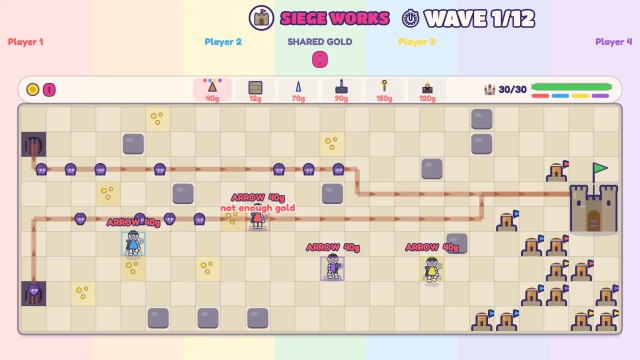
Twelve waves and then the Siege Engine, with a ten-minute cap. Enemies enter at the gates on the left and walk to the keep on the right along a dotted line that is always drawn — and the line is not scripted. It is found afresh around whatever you build, on the same frame a wall lands. Put a wall down and watch the line move. That is the game.
You start with a short build gap and a purse shared by the whole table. There is no build phase after that: the eight seconds between waves is a gap, not a mode, and towers can go down mid-wave. Button 1 places the selected tower on your square; button 2 cycles what is selected. The ghost turns red and says why when a square will not do — and the one rule you cannot break is sealing the way. Every placement is tried first, and one that would cut any gate or any walker off from the keep is refused with 'that would seal the way'.
Six things to build: arrow towers are cheap, fast and hit one target; walls have no gun and are pure maze; frost does no damage but slows everything near it; cannons are slow, splash, and runners outrun them; tesla chains and cuts straight through shields; mines make gold, on ore squares only. Every tower but the wall has three tiers. Selling returns 60% and redraws the path, so a bad maze is recoverable at a price.
Gold comes from kills, from mines, from a bonus at every wave clear, and from 6% interest on whatever is in the treasury at the end of a wave, capped so that hoarding early cannot snowball. The research bar spends it on five shared tracks: sharper towers, longer range, faster firing, more gold per kill and mine, and masonry, which adds to the keep and repairs it on the spot.
The waves teach the towers. Runners are quick and thin. A swarm wants splash. Brutes shrug off arrows and are cannon food. Wave six brings fliers, who ignore the maze and fly straight at the keep. Wave eight brings shields, which grow back too fast for a lone arrow tower — frost stops them regrowing, tesla ignores them. Wave twelve is everything at once. Then the Siege Engine: every other enemy that gets in costs the keep a point or two of health; the Engine reaching the gate ends it.
Scoring and winning
One keep, one treasury, one research tree: the table wins or loses together. Win by bringing the Siege Engine down, or by holding the keep to the ten-minute clock. Lose when the keep's health reaches zero or the Engine touches the gate.
Individual scores rank the builders: damage your towers dealt, bounties on their kills, gold your mines dug and research you paid for. A frost tower earns a share of the damage everything else does to whatever it is slowing. While you play, the scorebar shows the shared gold; these scores appear on the final card. The card names the top builder — but only crowns one on a keep that held. Alone, your score goes to the leaderboard.
Tips
- Fliers are why the perfect spiral is not the whole game. Build something with reach near the keep, not only along the maze.
- Shields are a choice with two answers, frost or tesla, which is what makes it a decision.
- Research is priced against towers. Rank one of Sharpen costs three arrow towers you did not build; buy it first and you lose wave four, buy it never and you cannot afford the boss.
- Stick and button 1, towers dropped wherever you stand, gets a solo run to about wave seven. Placing arrows sensibly and tiering them up with button 3 gets to nine or ten. Mines and research first wins most often.
- The keep's own cannon is a toy, deliberately: about five percent of the damage in a run. Nobody could mistake it for a strategy.