How to play
Iron Frontier
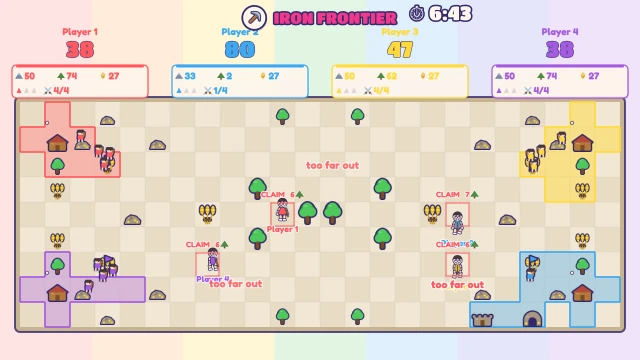
Claim land, mine it, raise an army, and take the other players' land — or lead on points when time runs out.
At a glance
- Players
- 1–4 at once
- Ages
- 8 and up
- Round
- Minutes — a sit-down game
- In the packs
- Party, Arena, Big Kids
Controls
The stick and button 1 are enough to play. The rest add moves for the older kids.
| What you press | What it does |
|---|---|
| Stick | move your prospector one square at a time |
| Button 1 — the big button | claim the square you are on, seize a rival's, build the sensible building here, or repair it |
| Button 2 | pick a building: auto, mine, sawmill, farm, barracks, turret, wall — button 1 builds it wherever it fits and you can pay, and the pick goes back to auto after eight seconds unused |
| Button 3 | rally: plant your flag here, and your soldiers walk to it |
| Button 4 | train a soldier at your nearest barracks |
| Button 5 | advance to the next age |
| Button 6 | sprint |
How a round goes
Seven minutes on one shared map, with no fog and no scrolling: the whole grid is always on screen and the map is the scoreboard. Every other big game is co-operative; this one is not. Alone you play Robo.
Land: you may only claim ground touching ground you already hold, so your territory grows as one blob and its shape is the story of the match. Claims cost timber and get dearer the more you hold. A rival's empty square next to yours can be seized for two and a half times the price — but not while an enemy soldier stands near it, and not while a building is on it. Territory changes hands behind an army, not in front of one.
Resources: ore, timber and grain, from mines, sawmills and farms built on the matching node — a mine on ore, a sawmill on timber, a farm on grain. Nodes in the contested middle are worth up to three quarters more than the ones in the safe corners. Your town hall earns a trickle on its own, so a player reduced to nothing still earns. Farms also raise how many soldiers you may keep.
Army: barracks recruit soldiers by themselves, and button 4 buys one on the spot for ore and grain. Soldiers are never commanded one by one: they walk to your flag and fight whatever they meet on the way, so moving the flag is the same decision as ordering an attack. Soldiers fight better near their own hall. Turrets and halls shoot on their own.
Ages: Stone, Iron and Steam. Advancing costs ore and grain — never timber — and each age makes every gatherer richer, soldiers stronger and recruits faster. Iron unlocks turrets; a Stone Age town still throws rocks.
Losing your town hall wipes your buildings, land and army, but the wagon rolls on: you resettle on the neutral square furthest from every rival with a small stake and a sturdier hall. Losing that one is elimination.
Scoring and winning
Five points per square held, twelve per building, one per fifty resources banked — a tiebreaker, never a strategy. The round ends at seven minutes with most points winning, or the moment only one side is left standing.
Four players with the team row on is two against two, stations 1 and 3 against 2 and 4, sharing one stockpile, one flag, one age and one hall. Alone, your score goes to the leaderboard, win or lose.
Tips
- Button 1 is a whole game: on an unclaimed square it claims, on a rival's it seizes, on your own empty square it builds the sensible thing for that ground, on a building it repairs — and when none of those apply it claims the best neutral square beside you, so a press is never wasted.
- Robo beats a random masher every time and loses to a player who builds three gatherers before their first barracks.
- Repair for six timber instead of rebuilding for twenty-two. A half-wrecked mine works at about three-quarter speed.
- Keeping your soldiers where your work is, is the game. An army left standing on the doorstep is not playing it — re-rally onto yourself when the fight comes to you.
- Turtling is poor and the way back is forward: the richest nodes are in the middle.