The Invite · free with every package
Every party gets its
own website.
A countdown, the address, a map, and one-tap RSVPs that land in your inbox. Your guests don’t download anything or make an account. On the day, the same page shows the party highlights: rounds played, the favourite game and wins by station colour — no names.
No ads. No trackers. No account. Not now and not later.
Check my party dateSee all 43 designs
Live about a minute after you book. The link never changes, so you can text it before you have decided anything else.
One booking, four things
- The invitation itself, at a link that never changes
- A printable flyer with the QR code on it
- A calendar file, so the date lands in their phone
- The party highlights, on the same link from party day — no names
8
You're invited
Ava
is turning 8 — Ava's 8th birthday
Saturday, November 14 · 3:00 PM – 6:00 PM
Hatching in
21 days to go.
Where & when
- When
Saturday, November 14
3:00 PM – 6:00 PM
- Where
The Ferreira house
128 Almond St, Ashland, OR
Open in maps (opens in a new tab)- RSVP by
Saturday, November 7
Catch 8 drops
Tap them before they land — one for every year.
There's a tap-the-drops game here, held still because your device asks for less motion. Everything about the party is below.
8
You're invited
Ava
is turning 8 — Ava's 8th birthday
Saturday, November 14 · 3:00 PM – 6:00 PM
Hatching in
21 days to go.
Where & when
- When
Saturday, November 14
3:00 PM – 6:00 PM
- Where
The Ferreira house
128 Almond St, Ashland, OR
Open in maps (opens in a new tab)- RSVP by
Saturday, November 7
Catch 8 drops
Tap them before they land — one for every year.
There's a tap-the-drops game here, held still because your device asks for less motion. Everything about the party is below.
A real invitation, with an invented child in it
What a guest sees
One page, and it answers the four things they came for.
It is the page a parent reopens on the morning of the party while putting shoes on a child. Nothing on it is more than a thumb-reach away.
Whose party, and when
The name, the age, and a countdown in days. That countdown is why guests come back three to five times instead of once.
Where, with a map link
The address opens whichever map app is already on the phone. No embedded map, because an embedded map is a third party watching your guests.
A two-tap RSVP
Three big buttons, a name, and how many children. No account, no password, no app, no email address required.
The party, in numbers
From the moment the arcade starts, the page shows the party highlights: rounds played, the favourite game and wins by station colour. The stations are the teams, so no child is named or ranked.
It has to load in under a second and a half on a mid-range Android on cellular, because that is literally the phone this runs on. That budget is why the page has no carousel, no video header and no font it did not already need.
The RSVP
Two taps, and you know how much cake to buy.
Every field is answered by the parent. Nothing on this page is ever asked of a child, and there is no step where anybody is invited to create an account.
1
You text one link
Straight into the class group chat. The preview that appears in the message is your child's name and your theme, not our logo.
2
They tap it
The invitation opens. Name, age, countdown, date, time, and the address with a map link. Nothing loads before it.
3
Three buttons
We'll be there · Maybe · Can't make it. That is the whole decision, and it is the first thing under the party details.
4
A name and a number
Who is replying, and how many children they are bringing. Allergies and a note to you are optional, labelled as being for the host only, and deleted after the party.
5
Done, plus a calendar entry
“You're in”, and one tap to put it in their calendar with your address already in it. Then one line — not a banner — asking whether their own child has a birthday coming up. Optional, from the parent, with the reason written next to it.
That last line is the only thing on the entire invitation that asks a guest for anything, it appears after they have replied and never before, and it is the reason this page can be free. We would rather tell you that than pretend it is not there.
The honest bit
Free, ad-free, permanently. Here is why that is safe to believe.
Roughly eighteen households open your invitation three to five times each. Every one of them contains a child within about eighteen months of the same age, in the same town, in the same income band, whose birthday is also coming. There is not a more valuable little audience in this business, and somebody would pay us for it.
We are never going to sell it, and the reason is not virtue. That invitation is how people find us. A parent at pickup asking “where did you get this?” is worth more to us than any banner, and a banner is the fastest way to stop them asking. Monetising the invitation would mean monetising the thing that does our marketing.
So the rule is simple and it is written into the product: we gate the games, never the invitation. The invitation site is not a tier and not a trial. It comes with every package we sell, including the $29 digital one, and there is no version of Bashcade where you pay us for an invitation.
What is never on that page
- Ads. Not a banner, not a sponsored line, not a partner offer.
- Third-party pixels, tags or analytics. Nobody else gets a request from your guests at all.
- Popups, interstitials, cookie walls, or an email gate in front of the address.
- An account. There is nothing to sign up for and nothing to install.
- Anything at all collected from a child. Every field is answered by a parent.
- A second ask. One soft line after the RSVP is the whole of it.
The children’s privacy notice says all of this in the language a lawyer would use, and it says the same thing.
Party day
At three o’clock the countdown becomes the party in numbers.
The same link, unchanged, on the same page the guests have been checking for a fortnight. Rounds played, minutes of play, the most-played game and wins by station colour — counted by the arcade itself, and up to date whenever the page is reloaded.
- It works on any phone with no login, and there is no name on it: the four stations are the teams, so no child comes last.
- After the party it stays as the party in numbers — the card you show the grandparents.
- The arcade keeps counting with the internet off; the rounds send themselves once it is back.
- You can switch the highlights off in your account, and guests see only the invitation.
Party highlights · wins by station colour
- rounds played
- 46
- minutes of play
- 94
- different games
- 12
- 3Yellow Most winsStation 311 wins
- 1RedStation 19 wins
- 2BlueStation 27 wins
- 4PurpleStation 46 wins
No names here — every station was a team.
An example, not a real party
Themed to match
The link you text the class looks like the party.
A theme pack reskins the arcade and the invitation together, so the page your guests open is the same dinosaur as the cake, the plates and the TV in the corner.
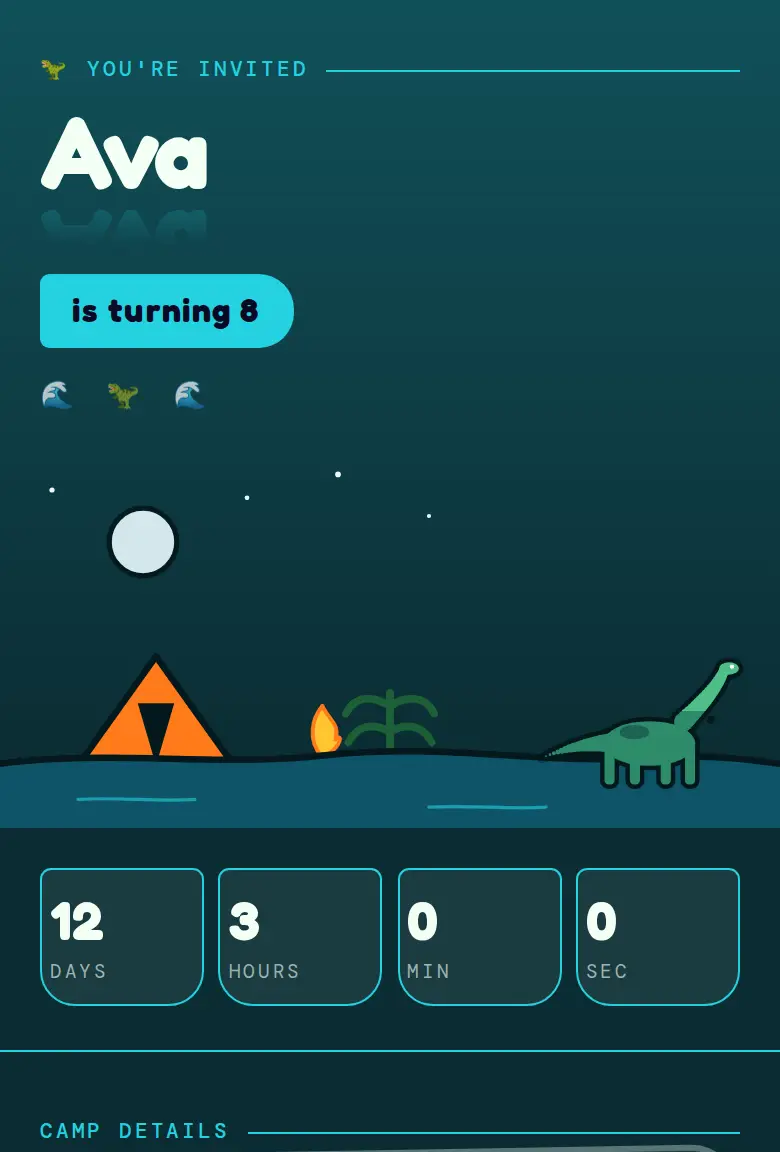
You're invited
Ava
is turning 8 — Ava's 8th birthday
Counting down
21 days to go.
When & where
- When
- Saturday, November 143:00 PM – 6:00 PM
- Where
- The Ferreira house128 Almond St, Ashland, OROpen in maps (opens in a new tab)
- RSVP by
- Saturday, November 7
Come and play
Catch 8 drops
Tap them before they land — one for every year.
There's a tap-the-drops game here, held still because your device asks for less motion. Everything about the party is below.
On paper, too
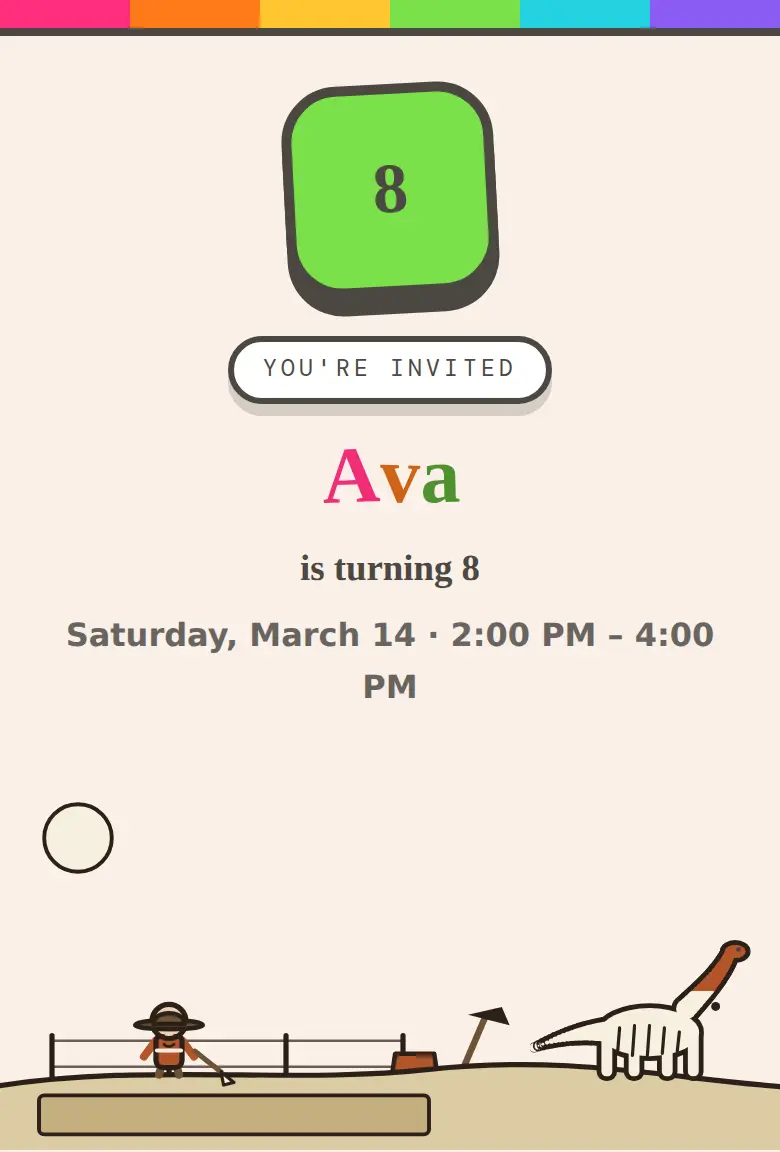
A flyer with the same face, and a code that opens the invitation.
Some classes still hand out paper, some grandparents do not use group chats, and a card in a party bag is how the invitation reaches the family that never saw the text. Every design prints as an A5 or a US Letter sheet with a QR straight to your invitation site.
- Print your own, free. Your browser’s own print dialog saves it as a PDF, and the sheet is laid out for it.
- The code goes to the invitation itself — the countdown, the address and the RSVP. Never an app store, and never a link that stops working.
What is on the sheet
- The party
- Name, age, date, time and address, in the theme's own colours and type.
- The code
- A QR to your invitation site, printed on white whatever the theme does, so every camera in the room reads it.
- Two papers
- A5 for a half-sheet you can run two-up, or US Letter for the paper already in the printer.
- An ink switch
- A version on white paper for anybody who has looked at the price of a colour cartridge.
The honest answers
Six things parents ask about the invitation.
Do my guests need an account?
No. There is no sign-up, no app and no email wall. They tap the link you texted them, read the party details and answer in two taps. We do not know who they are and we do not ask.
Is it really free?
Yes, and it is not a trial. The invitation site comes with every package we sell, including the digital one, and there is no version of Bashcade where you pay us for an invitation. What we charge for is the arcade.
Will there be ads on it?
Never. Roughly eighteen households open your invitation three to five times each — an audience somebody would happily pay us for. Selling it is the fastest way to stop parents asking where you got this, and that question is worth more to us than a banner.
Can I make it private?
The address is only ever on a page with an unguessable link, and that page is never indexed by search engines. If you want a second lock, set a password and guests are asked for it before anything loads.
What happens on the day of the party?
The countdown becomes the party highlights: rounds played, the favourite game and wins by station colour, counted by the arcade and there on any phone with no login. There are no names on it — the stations are the teams.
What do you do with the RSVPs?
We show them to you and nobody else. Guest names and allergy notes are kept for the party and deleted afterwards on a fixed clock, and nothing is ever asked of a child — every field is answered by a parent.
When’s the party?
Book a date and the invitation site is live about a minute later, ready to text. The arcade is what you are paying for; this part comes with it.